A tuple is an assortment of items which requested and permanent. Tuples are successions, very much like records. The contrasts among tuples and records are, the tuples can't be changed not normal for records and tuples use enclosures, though records utilize square sections. Making a tuple is pretty much as straightforward as putting diverse comma-isolated qualities. Alternatively you can put these comma-isolated qualities between enclosures moreover. For instance − tup1 = ('material science', 'science', 1997, 2000); tup2 = (1, 2, 3, 4, 5 ); tup3 = "a", "b", "c", "d"; The void tuple is composed as two enclosures containing nothing − tup1 = (); To compose a tuple containing a solitary worth you need to incorporate a comma, despite the fact that there is just one worth − tup1 = (50,); Like string files, tuple records start at 0, and they can be cut, linked, etc. Getting to Values in Tuples To get to values in tuple, u...
Iterative - Iterations in simple language is Practice. In real life when a student is preparing for an exam at that time if he/she needs a lot of practice, reading, following exercise questions, and providing our answers to understand the subject/ topic. Then n then only we get expertise in that particular concept or you can say area. And if you get more accuracy after practicing then you will get a high rank in that area right. Similar way we need to train our Machine Learning model so that they can be accurate at every time once we deploy them that's why this kind of learning is called Iterative Learning. For this, we need to train our model with different kinds of data set so our model can learn first. The machine also needs to understand data, process it, and produce more accurate output. Most of the time Iterative Learning can be most accurate and faster. At the end of the day, iteration will result in an error-free return in investments.

Figure. Iterative Learning
Machine learning needs to train models on different data sets before being deployed. Some machine- learning models are online, and which also needs continuous training to learn. This iterative process of online models causes an improvement in the types of associations made between data sets. As the data is much complex and large, these patterns and associations could have easily been overlooked by human observation. After a model has been trained with different data sets, it can be used in real-time to learn from huge data and get us back with more accurate results. The progress inaccuracy leads to the result of the training process and automation that are part of machine learning.
Machine learning came across a wide range of techniques like Decision trees, regression, learning algorithms- Supervised learning or unsupervised learning, classification, deep learning till advanced neural networks, reinforcement learning which is built in it. They why we still need Iterative learning? As stated above Iterative can reduce error margin so it helps us to produce more accurate results.
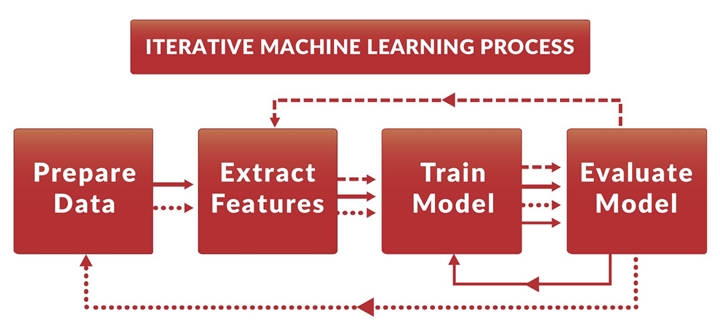
Figure. Iterative Learning Process
Let see that How Iterative Learning works in terms of Machine Learning
For this, we need to understand how iteration works by going in deep at what happens during a single iteration flow within a machine learning algorithm.
Below are the steps –
1. Get data set for training our model
2. Analyze data set
3. Pre-process data as per requirement
4. Pre-processed training data set provide input to our model.
5. After processing and model building with the given data, the model needs to go through random testing which should pass through several standard test cases. And once it passes from this step, we got accurate results.
6. Now the results are needed to be matched with the desired result/expected output.
7. The feedback is then returned to the system for that algorithm for future learning and get more tuned results.
This clearly shows that two iteration processes take place here:
Now, what if we did not feed the results back into the system i.e. did not allow the algorithm to learn iterative but instead adopted a sequential approach? Would the algorithm work and would it provide the right results?
Yes, the algorithm would work perfectly here with this approach. However, the quality of the results it produces might not more accurate based on several factors. The quality and quantity of the training data set to play a major role here, the feature definition and extraction techniques employed, the robustness of the algorithm itself are among many other factors. Though all the above work perfectly, there is still no guarantee that the results produced by a sequential approach will be highly accurate. In short, the results may not be accurate nor reproducible. So that Iterative learning thus allows algorithms to improve model accuracy.
Certain algorithms have several iterations per their design and can be scaled as per the data size. These algorithms are at the forefront of machine learning implementations because of their ability to perform faster and better and accurate results.
To learn more about Artificial Intelligence, Machine Learning, and Data Science.
Visit, InsideAIML
Comments
Post a Comment