A tuple is an assortment of items which requested and permanent. Tuples are successions, very much like records. The contrasts among tuples and records are, the tuples can't be changed not normal for records and tuples use enclosures, though records utilize square sections. Making a tuple is pretty much as straightforward as putting diverse comma-isolated qualities. Alternatively you can put these comma-isolated qualities between enclosures moreover. For instance − tup1 = ('material science', 'science', 1997, 2000); tup2 = (1, 2, 3, 4, 5 ); tup3 = "a", "b", "c", "d"; The void tuple is composed as two enclosures containing nothing − tup1 = (); To compose a tuple containing a solitary worth you need to incorporate a comma, despite the fact that there is just one worth − tup1 = (50,); Like string files, tuple records start at 0, and they can be cut, linked, etc. Getting to Values in Tuples To get to values in tuple, u...

What are Data Mining functionalities?
Data mining functionalities are used to specify what kind of pattern are present in our data during data mining tasks.
We can further divide data mining tasks into two different categories.
1. Descriptive mining task
2. Predictive mining task
Descriptive mining task
In descriptive mining tasks we try to find out the general properties present in our data. For example, we find data describing patterns and come up with new and significant information present in our available dataset.
Predictive mining task
In predictive mining tasks we try to find out some inference on the current data in order to make some predictions from the available data for the future.
What is Characterization and Discrimination?
When we try to summarize some general characteristics or features present in our target class of data then it's known as Data Characterization. Whereas when we try to compare general features of target class data objects with the general features of objects form one or a set of contrasting classes then its known as Data Discrimination.
What we try to find during data mining?
While performing data mining we try to find out what frequent pattern is present in the data, is there any associations is present in our data and does our data have some correlation present in them.
Frequent Pattern
Here, we try to find out what are some frequent patterns present in our data. There are many kinds of frequent patterns present. Some of the present patterns are subsequences, item sets, and substructures.
Association analysis
Association analysis is a type of analysis where we try to find out is there any association present in our data.
Let’s imagine, you are a store manager of a big mart, you want to find out that which items are frequently purchased together within the same transactions.
For example, we may know, most of the time bread and butter are purchased together, egg and bread are bought together.
Purchased (X, “bread”) = Purchased (X, “butter”) with support = 1% and confidence = 50%.
Here X represents a variable customer. Confidence = 505 means that is a customer purchase a bread, there is a 50% change that he/she will also buy butter.
Support = 1% means that from all the transactions taken under analysis bread and butter were purchased together in 1% of all the transactions.
Classification and Prediction
Classification is a process where we try to find a model that can describe and distinguishes data into different classes and then the model can be use for the prediction of the class of objects whose class label is unknown.
What is Cluster Analysis?
When we try to divide our data into different clusters based on some similarity between the data points where we don’t have a target variable then it is known as Cluster Analysis or Clustering.
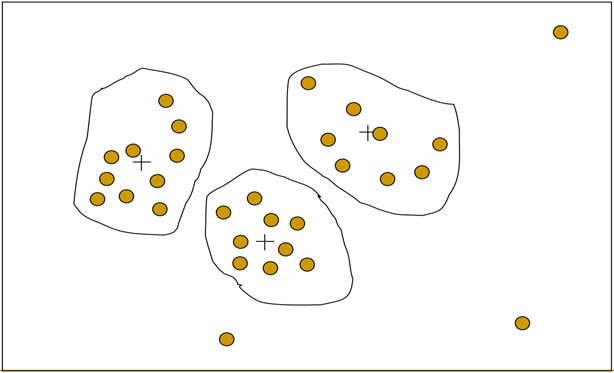
From the above figure, we can see that the data points are divided into three different clusters based on some similarities between the data points.
I hope after reading this article, finally, you came to know about what are some of the Verified data mining functionalities?
For more blogs/courses on data science, machine learning, artificial intelligence, and new technologies do visit us at InsideAIML.
Thanks for reading
Comments
Post a Comment